Sunday, February 17, 2019

Pulwama attack: India mourns Kashmir dead
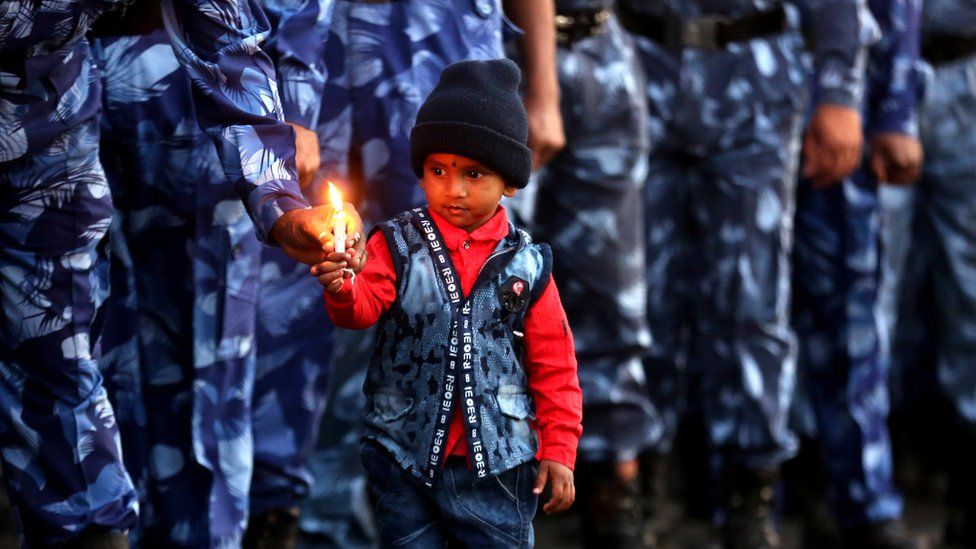
Rapid Action Force soldiers and a child from one of their families hold candles as they pay tribute to personnel during a candlelight vigil in BhopalImage copyrightEPA
Thousands of mourners have been attending funerals across India for some of the security force personnel killed by a suicide bomber in Indian-administered Kashmir on Thursday.
At least 40 paramilitary police died in the attack near Srinagar.
The militant group Jaish-e-Mohammad said it carried out the attack.
India has imposed a swathe of economic measures on Pakistan after the attack, including revoking Most Favoured Nation trading status and raising customs duty to 200%.
Although Jaish-e-Mohammad is based in Pakistan, Islamabad has denied any role in the attack.
Both India and Pakistan claim all of Muslim-majority Kashmir but control only parts of it.
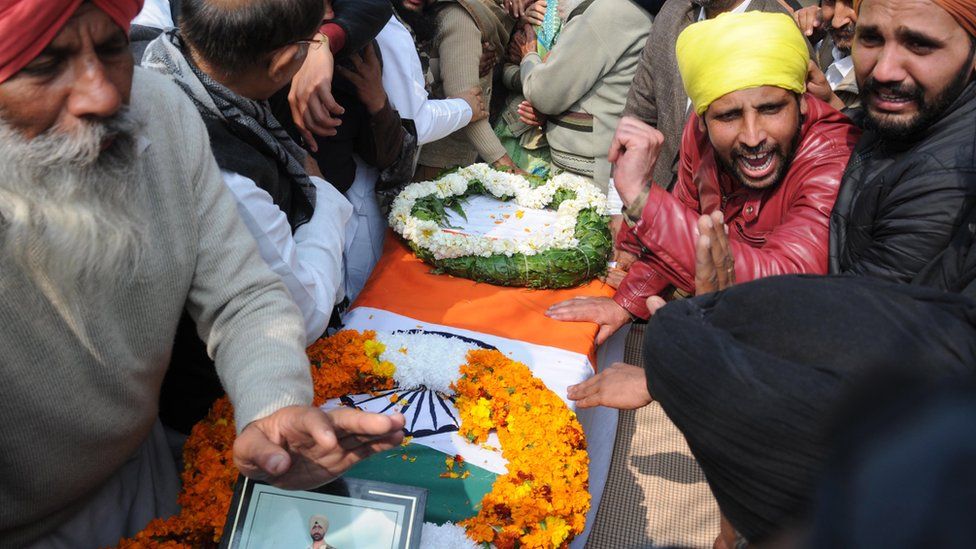
Relatives of Central Reserve Police Force soldier Sukhjinder Singh mourn near his coffin before his cremation ceremony at village Gandiwind in Tarn Taran districtImage copyrightEPA
Relatives of Central Reserve Police Force (CRPF) soldier Sukhjinder Singh mourn as his coffin is taken to his cremation ceremony at the village of Gandiwind in the Tarn Taran district of India's Punjab state.
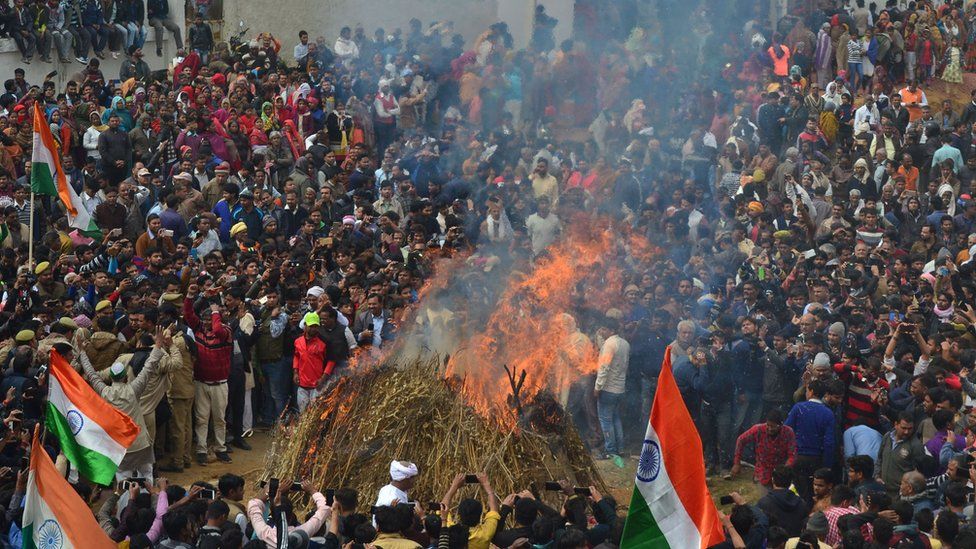
Mourners gather to watch the cremation at the funeral for Indian Central Reserve Police Force (CRPF) trooper Kaushal Kumar Rawat in AgraImage copyrightAFP
The cremation is held for CRPF trooper Kaushal Kumar Rawat in Agra.
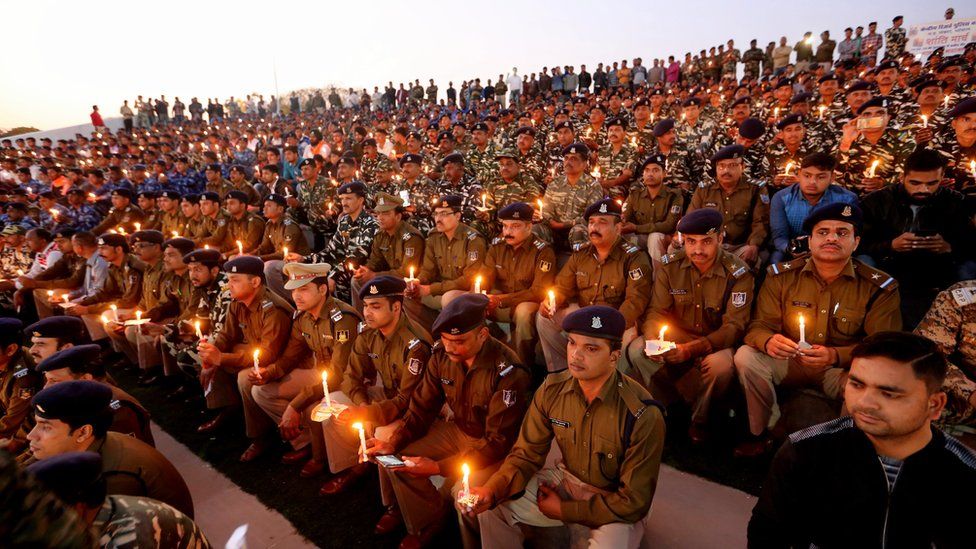
Central Reserve Police Force and Rapid Action Force soldiers and their family members hold candles as they pay tribute to personnel during a candlelight vigil in BhopalImage copyrightEPA
CRPF and Rapid Action Force soldiers hold candles in tribute to dead colleagues during a vigil in Bhopal.
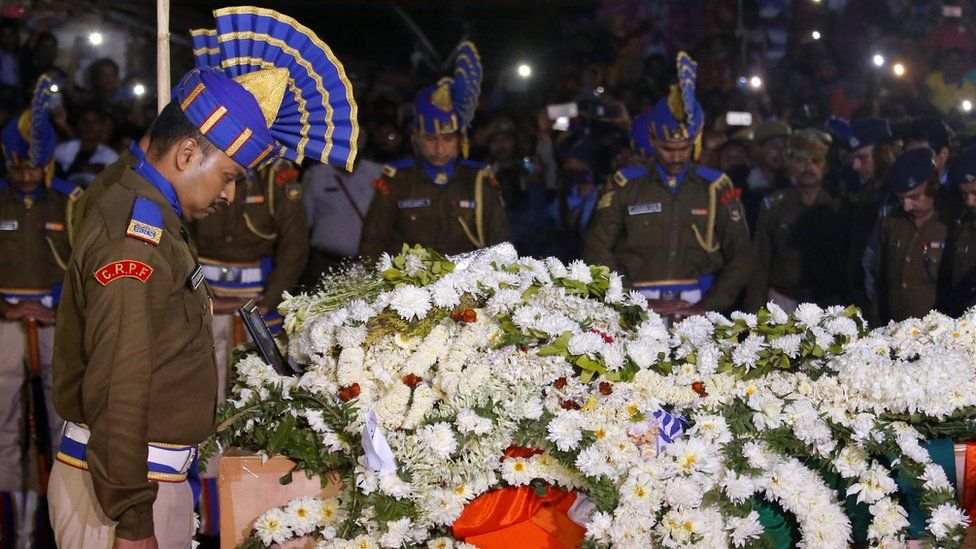
Central Reserve Police Force (CRPF) officers bow to pay tribute next to a coffin containing the remains of their colleague Bablu Santra in Howrah, West BengalImage copyrightREUTERS
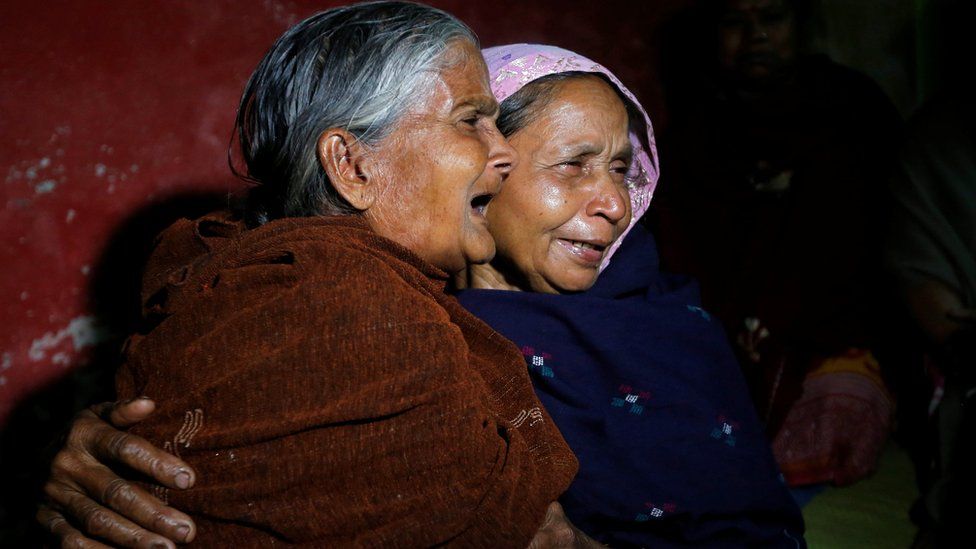
An elderly woman cries as she hugs Bonomala Santra (R), mother of Bablu Santra, a Central Reserve Police Force (CRPF) trooper killed on Thursday, at Bauria village in Howrah district, West BengalImage copyrightREUTERS
CRPF officers bow in tribute (top) to colleague Bablu Santra in Howrah, West Bengal, as his mother (above right) mourns him in the village of Bauria.
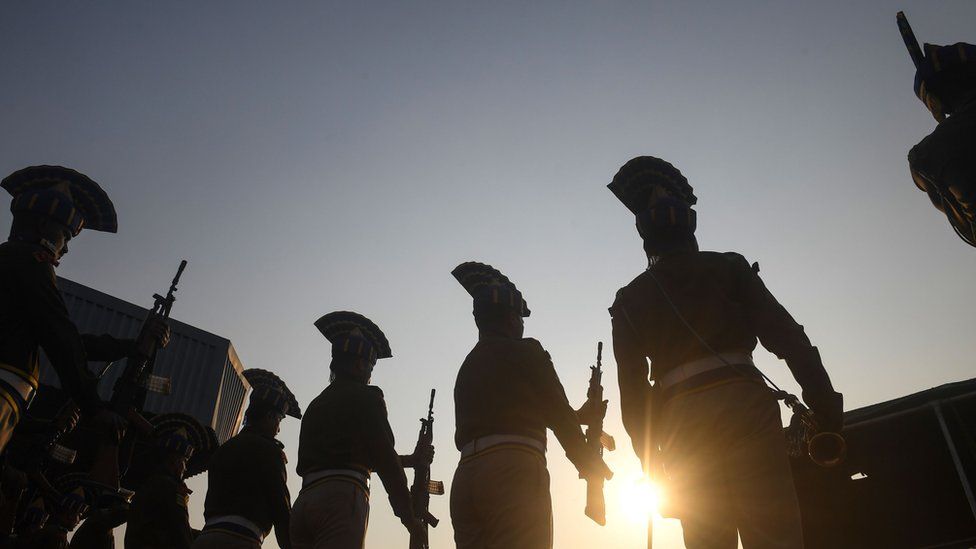
Indian Central Reserve Police Force (CRPF) personnel stand as a guard of honour for colleagues Sudip Biswas and Bablu Santra at Kolkata airportImage copyrightAFP
CRPF personnel stand guard over the coffins of Sudip Biswas and Bablu Santra at Kolkata airport.
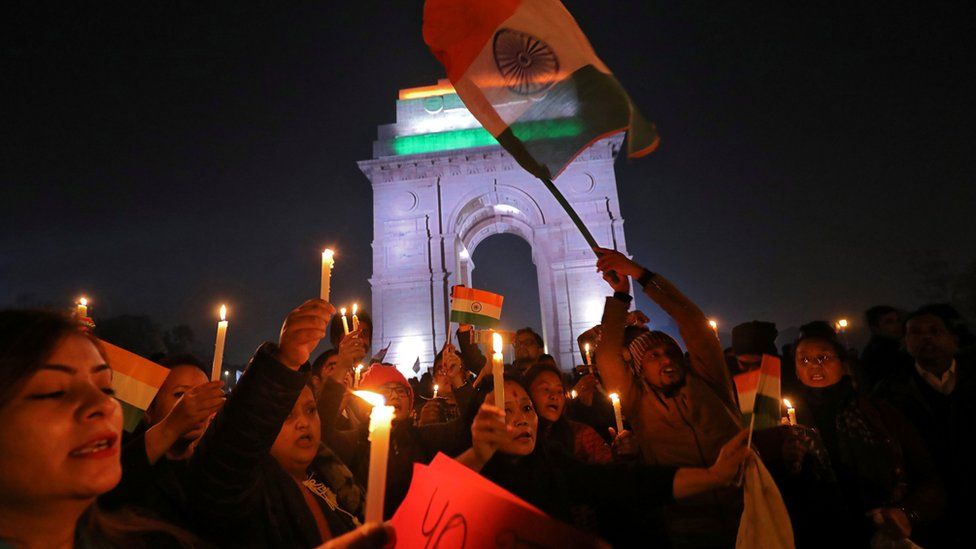
People attend a vigil in front of India Gate war memorial in Delhi, for personnel killed on ThursdayImage copyrightREUTERS
People attend a vigil in front of the India Gate war memorial in Delhi.
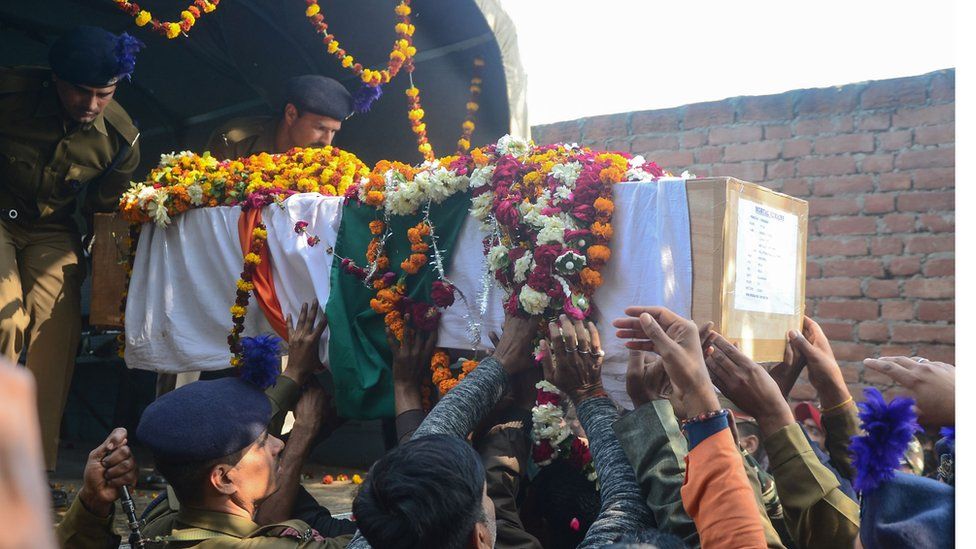
Mourners touch the coffin as they take part in the funeral procession for Indian Central Reserve Police Force trooper Mahesh Kumar Meena at Meja village, near AllahabadImage copyrightAFP
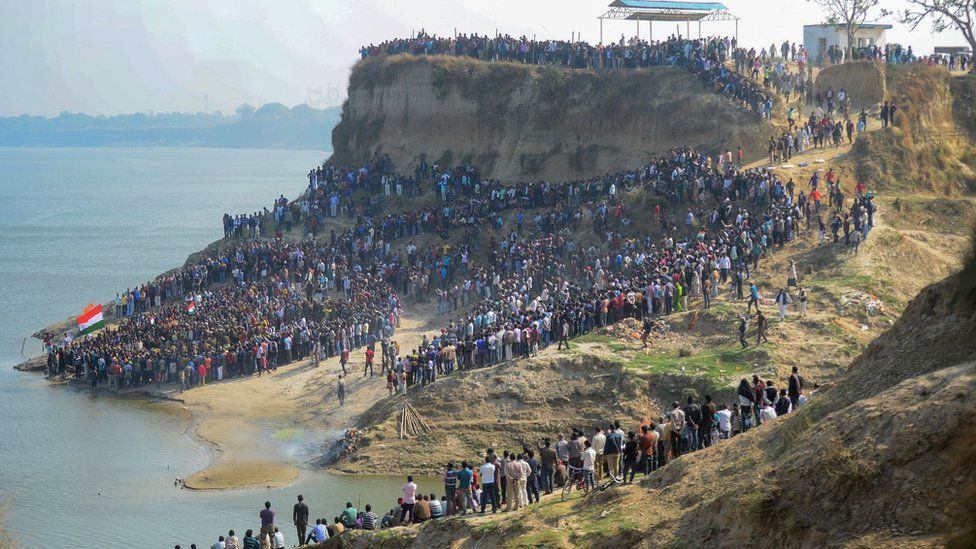
A large number of mourners gather on the bank of the Ganges river to attend the funeral procession for trooper Mahesh Kumar Meena near AllahabadImage copyrightAFP
The coffin of Mahesh Kumar Meena arrives near Allahabad (top) and hundreds gather on the bank of the Ganges for his funeral procession.
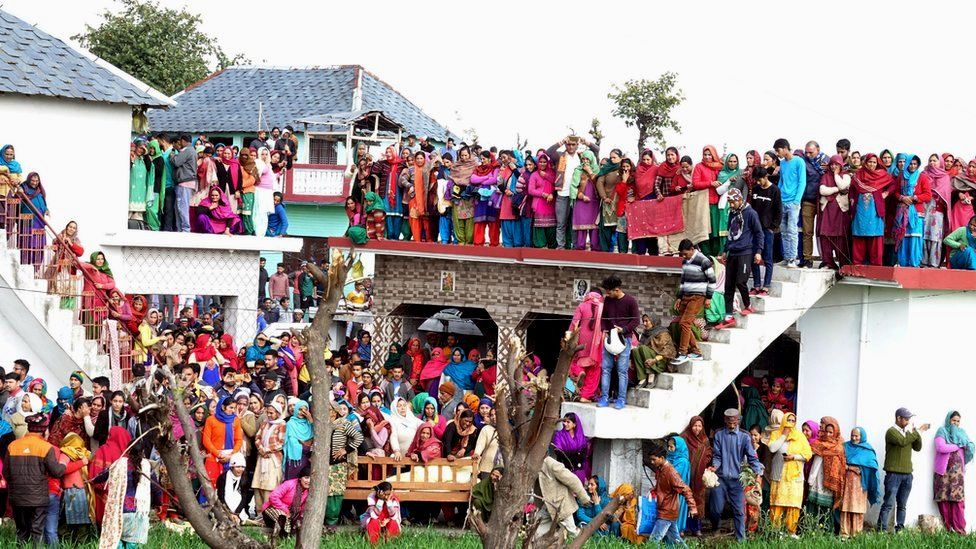
Villagers gather in large numbers as body of slain Central Reserve Police Force (CRPF) soldier Tilak Raj arrives at his home in village Dhewa Jandroh, some 90km from DharamsalaImage copyrightEPA
Dozens more gather for the return of the body of CRPF member Tilak Raj at his home in the village of Dhewa Jandroh, 90km (55 miles) from Dharamsala.
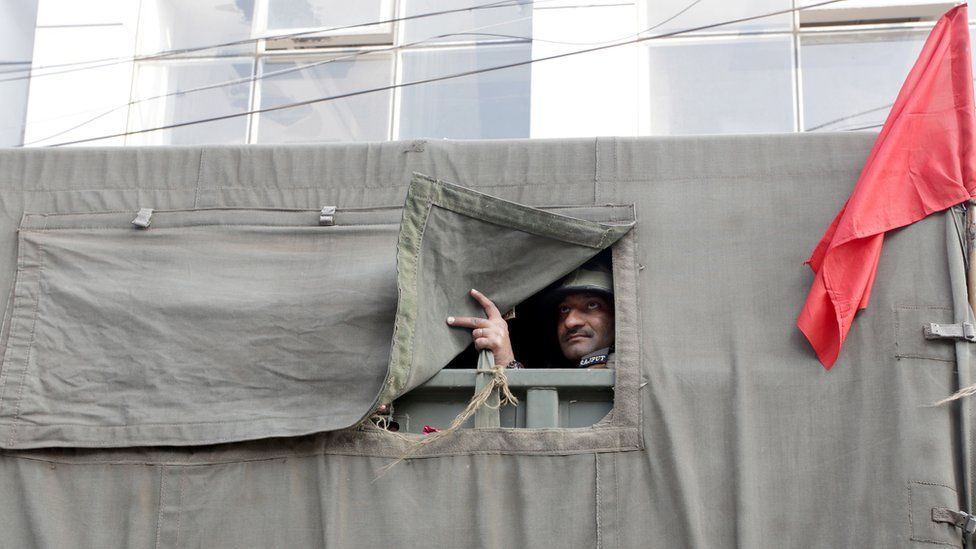
An Indian army soldier looks from the vehicle as they carry out a flag march during curfew in JammuImage copyrightEPA
Tension remains high in Jammu, Indian-administered Kashmir, amid a curfew.
All pictures copyright

Related Topics

Saturday, February 16, 2019

Pulwama attack: What is militant group Jaish-e-Mohammad?

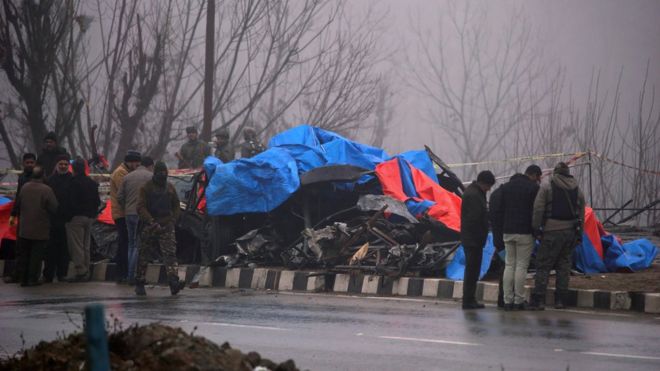
Pulwama attack aftermath February 2019Image copyrightREUTERS
Image captionIt was the single deadliest attack in Indian-controlled Kashmir since 1989
Jaish-e-Mohammad (JeM), a Pakistan-based group, has claimed responsibility for the suicide bombing on 14 February in Indian-administered Kashmir.
The group is designated a terror organisation by India and the UN, as well as the UK and the US.
It aims to unite Kashmir with Pakistan and has been held responsible for attacks in India and Kashmir.
Media reports say JeM spokesman Muhammad Hassan spoke of "dozens of [Indian] forces' vehicles" destroyed in the attack, when the bomber rammed a convoy in a vehicle filled with explosives.

What is JeM?

Jaish-e-Mohammad literally means the Army of Mohammad.
Pakistan-based Muslim cleric Maulan Masood Azhar founded the group after he was released by India in 1999.
He was one of three men set free in exchange for the crew and passengers of an Indian Airlines plane hijacked and flown to Taliban-ruled Afghanistan.
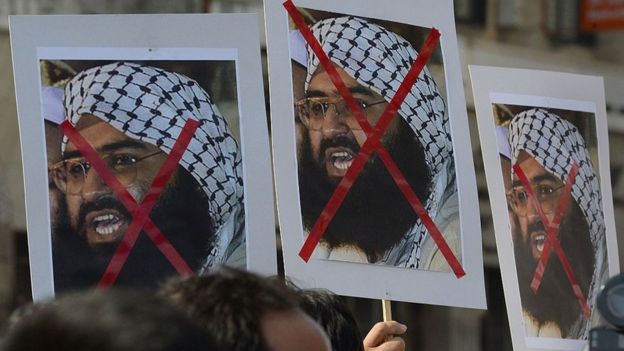
People protest carrying placards of Maulan Masood AzharImage copyrightAFP/GETTY
Image captionMaulan Masood Azhar founded JeM in 1999
Mr Azhar reportedly met with the former Taliban leader Mullah Omar and with al-Qaeda head Osama Bin Laden when he was in the country.
India blame JeM for an attack on their parliament in New Delhi in December 2001 - a claim JeM denies.
JeM was officially banned in Pakistan soon after that attack but the group still operates, sometimes using the names Afzal Guru Squad, Al-Murabitoon and Tehreek-al-Furqan.
More recently, India has blamed JeM for an attack on its Pathankot airbasenear the Pakistani border in January 2016, which left three security forces dead. 
JeM commander Noor Mohammad Tantray was killed by Indian forces in December 2017, which was seen as a massive blow to the organisation.
But the violence did not abate, and a report in the Indian newspaper The Print suggests covert Pakistani support may be the reason for its expansion.
JeM has however attacked Pakistani military targets and even made an attempt on former leader Pervez Musharraf's life in 2003, despite India's accusations that Pakistan harbours the group.

What have India and Pakistan said?

India frequently asks its neighbour to extradite Mr Azhar - reportedly in the eastern Pakistani province of Punjab - but Pakistan refuses, saying there is a lack of proof against him. 
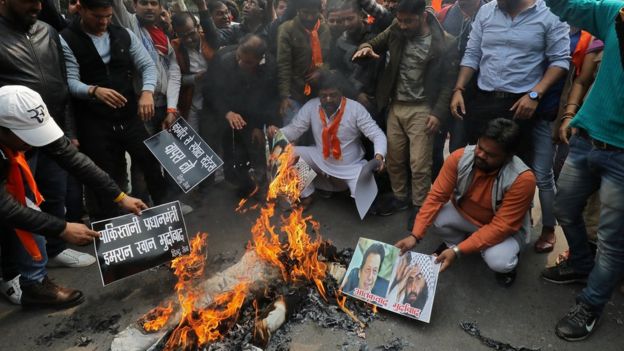
Right wing Hindus burn photos of Mr Azhar and Pakistani Prime Minister Imran KhanImage copyrightREUTERS
Image captionRight wing Hindus burn photos of Mr Azhar and Pakistani Prime Minister Imran Khan
New Delhi has also called on the UN to list Mr Azhar as a global terrorist, but Pakistan's close ally China continues to block the move. 
Speaking after the Pulwama attack, India's foreign ministry demanded that Pakistan "stop supporting terrorists and terror groups operating from their territory, and dismantle the infrastructure operated by terrorist outfits to launch attacks in other countries".
But Pakistan has condemned any suggestion it is linked to the attack.
"We have always condemned acts of violence anywhere in the world," a foreign office spokesman said.

More on this story