But these state polls may be an unreliable barometer for next year's big elections.
For one, there was considerable anti-incumbency against the BJP in these states - the party was trying for a record fourth term in both Madhya Pradesh and Chhattisgarh. People in Rajasthan have a consistent record of voting out the incumbent after one term.
BJP workers will take solace from the fact that the party still put up a spirited fight in two of the three states, despite the formidable odds of anti-incumbency. The contest in Madhya Pradesh proved to be a cliffhanger, with the final result only becoming clear by Wednesday morning.
 AFP
AFP
Secondly, the majority of seats in the three states witnessed bipolar contests between the BJP and the Congress. In general elections, regional parties will hold the key. Next year much will depend on the kind of strategic regional alliances the Congress is able to stitch up and sustain in different states.
Thirdly, one of the BJP's greatest strengths is having capable leaders in several states, many of whom who have completed more than one term. Hobbled by dynastic politics, the Congress has failed to groom young local leaders, depending mainly on the charisma of the Gandhi family.
Also, the Congress appears to lack political imagination and has been unable to produce a powerful counter-narrative to the BJP.
"It seems to be counting on anti-incumbency to do the work, a complacent attitude that has made the BJP competitive in areas where it has gathered genuine discontent, against the lack of development outcome, unemployment and rural distress," says political scientist Gilles Verniers, who teaches at Ashoka University.
 EPA
EPA
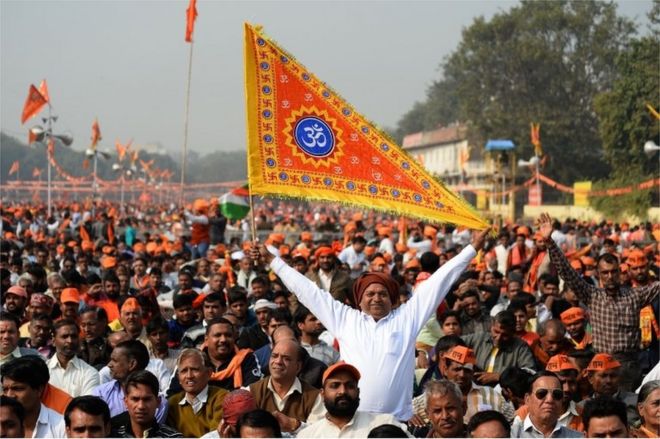
With its stridently Hindu nationalist ideology, the BJP now represents the political right and is the main conservative party in India. Regional parties have usurped the Congress's centrist politics, contributing to the party's sharp decline over the years.
It is also not clear whether the Congress has a grip on India's changing politics.
In their new book, Ideology and Identity, political scientists Pradeep K Chhibber and Rahul Verma from the University of California, argue that India "is no longer led by a Western-oriented elite and citizens have voted into power politicians closer to their roots, politicians who represent small-town socially conservative values, in the BJP or regional parties". This is a shift of power to a "more conservative and vernacular elite" which seems to have escaped the Congress.
What remains abundantly clear is that the 2019 general elections will be a referendum on Mr Modi.
In 2014, Mr Modi swept to power in what was an overwhelming verdict for change. His critics believe he has largely frittered away that vote. They say his rhetoric has moved from the politics of hope to the politics of grievance, mostly blaming the Congress for the country's ills.
The party has also stoked renewed calls to build a temple on the flashpoint Indian religious site of Ayodhya, where a 16th Century mosque was demolished by Hindu mobs in 1992. The BJP's stridently majoritarian politics, critics say, has fanned hate and left the country deeply divided. Some of India's important institutions like the federal investigation agency CBI and the central bank have been roiled by controversies, prompting many to believe that their independence has been eroded.
A day before the results were due in fact, the central bank governor Urjit Patel, unexpectedly resigned.
Mr Modi's grandiose promises - especially to create more jobs and increase incomes of farmers - have begun to bite. Lack of jobs and declining farm incomes will be the deciding issues next year, although whether the farmers will vote as an "angry bloc" against what is now being perceived as an "arrogant" government will become clearer closer to the summer polls.
But the failure to offer an alternative narrative of hope to the people will make it difficult for the Congress and its often fractious allies to mount a credible challenge to Mr Modi, who still remains the BJP's star vote-catcher.
In the end, says Pratap Bhanu Mehta, vice-chancellor of Ashoka University, the elections don't feel like the "buoyant narrative of a young nation marching into the future".
"At the end of the day, these elections are about a competing narrative only in a limited sense: A ruling dispensation full of arrogance, hubris, and willing to corrode all civil society and institutions competing with a Congress that is seen as a last defensive stance of an embattled republic."


No comments:
Post a Comment